
5 Surprising Truths About Convex Optimization (That Even Experts Get Wrong)
posted: 28-Dec-2025 & updated: 20-Feb-2026
Share this on LinkedIn | Instagram | Twitter (X) | Facebook
This is not a criticism, but an observation about the difference between procedural knowledge and genuine understanding. Recognizing this gap in one’s own comprehension—admitting that you can derive the KKT conditions but may not be able to explain their geometric essence—is the essential first step toward genuine mastery. It is a rare and precious form of self-awareness that opens the door to deeper insight.
Convex optimization is far more than a powerful computational tool. It is a field that reveals deep truths about problem structure, geometric insight, and the hidden symmetries that connect seemingly disparate problems. The journey from knowing its formulas to understanding its essence is a profound intellectual challenge.
Introduction - Beyond the Textbook
Optimization is a core concept in almost every quantitative field, from engineering and finance to machine learning and logistics. We are taught its principles and we apply its algorithms, often with great success. But for many of us, our understanding remains at the surface level. We know that certain methods work, but we rarely pause to consider the deep structure that makes them work.
There is a vast and often unrecognized gap between knowing a statement is true and grasping why it must be true—a gap most of us, even experts, rarely cross. This article, inspired by my work, aims to bridge that gap by sharing five of the most profound, counter-intuitive, and impactful takeaways from a deep dive into convex optimization. These are the ideas that transform the subject from a collection of techniques into a lens for seeing the world differently—even if you’re not a mathematician.
Related Articles
- When Every Path Leads to Success – The Convex Optimization
- Convex Optimization - Rigorous Mathematical Foundations
1. The “No-Drama” Landscape - Every Local Minimum is the Global Minimum
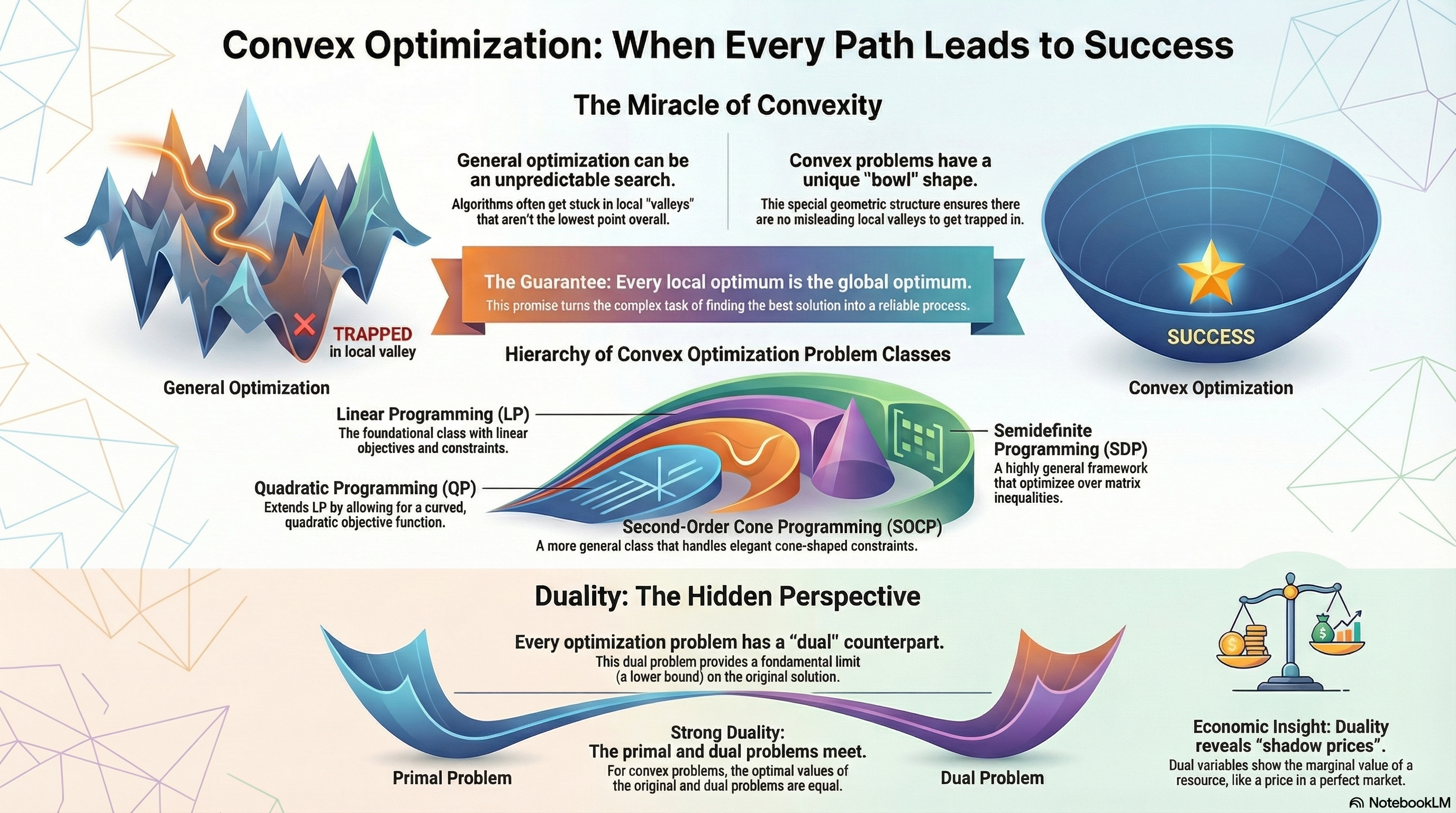
In general optimization, the search for the best solution is fraught with peril. The landscape is often filled with countless hills and valleys that can trap algorithms, leading them to a “local” minimum that is far from the true, “global” best. Finding the global optimum can be a computationally impossible task.
Convex optimization eliminates this drama entirely. For a convex problem, any local minimum is guaranteed to be the global minimum. The mathematical landscape has the structure of a single, perfect bowl. No matter where you start, any step downhill leads you closer to the one true bottom.
“The miracle of convex optimization lies in its fundamental promise – every local optimum is automatically a global optimum. This transforms the seemingly impossible task of global optimization into the manageable problem of finding any critical point.”
This single property transforms the seemingly impossible task of global optimization into the manageable problem of finding any point where the gradient is zero.
2. The “Shadow” Problem - Duality Reveals a Hidden, More Insightful World
For every optimization problem, which we call the “primal” problem, there exists a corresponding “dual” problem. This isn’t just a mathematical curiosity; it’s a hidden, parallel world that often provides deeper insight than the original formulation. But why on earth should this be true?
Consider the classic “vitamin problem” from optimization textbooks. The primal problem is to find the cheapest combination of foods that meets your daily nutritional requirements. Its dual problem is entirely different – assign a price to each nutrient to maximize the total value of the required nutrients, under the constraint that the value of nutrients in any given food cannot exceed that food’s cost. For convex problems, a property known as “strong duality” holds, meaning the optimal value of the primal problem is equal to the optimal value of the dual, i.e.,
\[p^\ast = d^\ast.\]The cost-minimizing diet is perfectly balanced by the value-maximizing nutrient prices.
These dual variables act as “shadow prices,” revealing the marginal value of each constraint. This economic view is just one facet of a deeper truth; duality also has profound interpretations in game theory, geometry, and sensitivity analysis, revealing it as a fundamental concept of equilibrium and symmetry.
3. The “Physics” of Optimization - Why Convexity Matters for Non-Convex Deep Learning
One of the most common questions today is, “Why study convex optimization in an age dominated by non-convex problems like deep learning?” After all, neural networks have complex loss landscapes with countless local minima, seemingly discarding the central guarantee of convexity.
The answer is that convex optimization provides the “physics intuition” for all optimization problems. Understanding it deeply gives you the right mental models for thinking about any optimization landscape, even highly complex ones.
Just as Newtonian mechanics gives you intuition for relativistic mechanics even though it’s technically wrong at high speeds, convex optimization gives you the right mental models for thinking about any optimization landscape.
This deep understanding allows researchers to know precisely what breaks and why when moving to non-convex problems. It provides the intuition behind many modern techniques in regularization, algorithm design, and architectural choices that help navigate the treacherous terrain of deep learning.
4. The Universal Recipe - KKT Conditions Are the Rules of the Game
For constrained optimization problems, how do we know when we’ve found a solution? The Karush-Kuhn-Tucker (KKT) conditions provide a universal and systematic set of rules that define optimality.
For general problems, these conditions are necessary for a point to be optimal. But for convex problems, they become both necessary and sufficient. This means if you can find a point that satisfies the KKT conditions, you have found the guaranteed global optimum. There is no need for further searching or second-guessing.
“The KKT conditions represent one of the most elegant bridges between geometry and analysis in all of mathematics, transforming constrained optimization from an art into a systematic science.”
One of the most beautiful KKT conditions is “complementary slackness.” It states that for any given constraint, either that constraint is active (pushed to its limit), or its corresponding “shadow price”—the marginal value we discussed earlier—must be zero. A resource is either priceless or free; there is no in-between.
5. The Expert’s Paradox - Why True Understanding is So Rare
Perhaps the most surprising truth is a human one. (I provocatively argue that) very few people—even professors who teach the subject and researchers who use it daily—truly understand convex optimization. If you are honest with yourself, I claim, the answer is “definitely and definitively NO!”
Many have a mechanical knowledge, able to apply formulas and run algorithms, but lack a deep, multi-faceted, intuitive grasp of the underlying principles. Consider the unproven Riemann Hypothesis. In a strict sense, no one on Earth truly understands it, because a genuine, first-principles understanding would enable a proof. Now consider Fermat’s Last Theorem, which Andrew Wiles famously proved. Being able to follow the hundreds of pages of his proof is still not the same as grasping the “essential reason why” the theorem must be true.
This is not a criticism, but an observation about the difference between procedural knowledge and genuine understanding. Recognizing this gap in one’s own comprehension—admitting that you can derive the KKT conditions but may not be able to explain their geometric essence—is the essential first step toward genuine mastery. It is a rare and precious form of self-awareness that opens the door to deeper insight.
Conclusion - From Knowing to Understanding
Convex optimization is far more than a powerful computational tool. It is a field that reveals deep truths about problem structure, geometric insight, and the hidden symmetries that connect seemingly disparate problems. The journey from knowing its formulas to understanding its essence is a profound intellectual challenge.
This very quest—the drive to move from mechanical knowledge to genuine, multi-faceted insight—is what inspired the creation of communities like Convex Optimization Forum I created. It is a journey that changes not only how you solve problems, but how you think about them in the first place.

This leads to a final question for you to consider: What foundational tools in your own field do you know are true, but would struggle to explain why they must be true from first principles?
Mathematical Genealogy: Carl Friedrich Gauss → … → C. Felix Klein → … → Stephen Boyd → Sunghee Yun