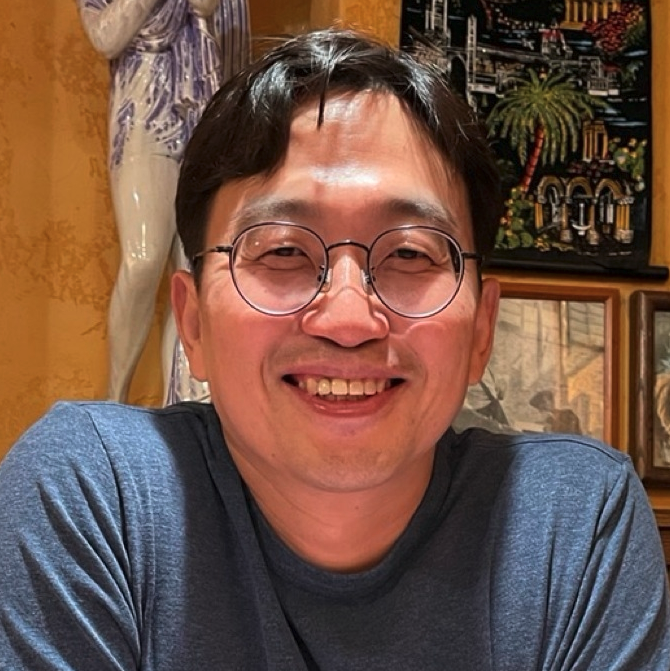
5 Life-Altering Ideas from a Philosopher-CEO’s Playbook
posted: 06-Jan-2026 & updated: 05-Mar-2026
Share on LinkedIn | Instagram | Twitter (X) | Facebook
Introduction - From Existential Dread to Intentional Design
The search for a meaningful life and a coherent career is a universal human quest. Hardwired into our consciousness, it can often feel like a journey through a dense fog, grasping for a map that doesn’t exist. Out of this fog comes a surprisingly clear playbook from an unlikely guide: Sunghee Yun, a mathematician, philosopher, and AI entrepreneur whose journey has spanned the depths of existential philosophy and the front lines of high-stakes tech.
This article distills five of Yun’s most powerful takeaways on meaning, career, and freedom. Forged in his journey through companies like Samsung and Amazon to founding his own biotech startup, these ideas are not just theories; they are the operating principles of a life designed with radical intention. They represent a cause-and-effect story: a single philosophical breakthrough that, once made, unlocked a new way of working, living, and thriving.
Idea #1 - Stop Searching for the Meaning of Life. Ask a Better Question.
For centuries, thinkers have treated meaning as a cosmic truth waiting to be discovered. Yun argues this is the fundamental error that sends us searching for a hidden answer that isn’t there. He contends that the most important philosophical move we can make is not to find a new answer, but to ask a completely different question.
The fundamental error that I, and virtually everyone on the earth and throughout the human history, have made is asking “What is the meaning of my life?”, “Why do I live?”, or “Why should I live?” whereas the right question to ask is “Do I want meaning of my life?”
This simple twist is the foundation for everything that follows. It shifts the entire focus from passive discovery to active creation. Meaning is no longer a cosmic obligation we must find, but a personal choice we can make. This realization places agency squarely in the hands of the individual, transforming the search for purpose from a daunting quest into a creative project. It is the key that unlocks the door to a self-authored life.
Idea #2 - Why the ‘Duty of Genius’ Is a Gilded Cage
Once Yun embraced the idea of creating meaning, he first had to dismantle the frameworks that imposed it from the outside. Early in his journey, he was captivated by the subtitle of a Ludwig Wittgenstein biography: “The Duty of Genius.” Raised by non-religious parents, Yun found this concept offered a powerful secular purpose: the idea that possessing an exceptional talent creates a moral obligation to use it for humanity. It provided a noble direction without requiring religious faith.
He soon discovered a flaw in this elegant logic. The inspiring idea, he realized, was a philosophical trap. While the impulse to contribute is admirable, basing one’s purpose on it is perilous. Yun identifies several critical flaws in this mindset:
- It confuses “is” with “ought”: Just because you can do something exceptional doesn’t mean you must. This confuses a fact about your abilities with a prescriptive duty about how to use them.
- It breeds fragility: This mindset can lead to a cosmic-scale “impostor syndrome.” If your meaning is tied to your exceptional contributions, your sense of purpose becomes dependent on meeting impossibly high expectations.
- It can be a form of self-deception: The belief that one has special duties because of special gifts risks becoming a form of narcissism disguised as altruism.
By rejecting this external obligation, Yun was free to design a career based not on what he felt he should do, but on what he chose to create.
Idea #3 - Forget Specialization. The Future Belongs to the “Connector.”
On paper, Sunghee Yun’s career makes no sense. He hopped from convex optimization at Stanford to semiconductor design at Samsung, e-commerce AI at Amazon, industrial AI at Gauss Labs, and finally, biotech AI at his own startup, Erudio Bio. But beneath the surface lies a powerful strategy, a direct application of his philosophy of creating meaning. Instead of discovering a pre-defined path in one field, he designed a unique one by connecting many.
The consistent thread is applying the core tools of AI and optimization to solve complex problems in wildly different domains. This became the cornerstone of his career.
My strength is not in the depth of one field, but in freely crossing the boundaries of several fields and integrating them, based on deep expertise in a few fields as an anchor.
This “connector” model is an act of professional meaning-making. In a world where the most significant breakthroughs happen at the intersection of disciplines, this strategy is exceptionally powerful. By building a deep anchor in a few core areas and applying them broadly, one can create value that specialists locked in a single silo cannot.
Idea #4 - The Entrepreneur’s Paradox: How 3x the Work Delivers 10x the Freedom
After co-founding his company, Erudio Bio, Yun discovered a paradox: his workload increased by two to three times, yet he gained an immense amount of temporal and mental freedom. This wasn’t just a better work-life balance; it was the ultimate expression of the choice he advocated for in his core philosophy. He didn’t just choose to have meaning; he built the company as the vessel for that meaning.
He attributes this to two factors:
- True Ownership: He became the “true and complete owner” of his time. No longer bound by a 9-to-5 structure, he could design the flow of his work and life in a way that aligned perfectly with his vision.
- Unleashed Imagination: He could finally execute his own vision without constraints, which he calls “the true freedom that only an entrepreneur can enjoy.”
This reveals that true freedom isn’t about working less, but about having full agency over your work and its purpose. It’s the tangible result of choosing to create your own meaning and then building the structure to support it.
Idea #5 - The Real Reward for Risk Is Not What You Think
It’s easy to look at Yun’s career and see a smooth path of success. He is quick to dismantle this myth, noting his journey was filled with uncertainty. This leads to his final principle for a self-designed life: the true reason to take a major risk is not to achieve the expected outcome, but for the “unimaginable amazing gifts” that await on the other side.
He offers concrete examples from his career pivots:
- Moving to Amazon: The goal was learning AI. The unexpected “gift” was deeply absorbing Silicon Valley’s culture of speed and scale.
- Founding Gauss Labs: The goal was building an industrial AI company. The “gift” was awakening a latent business insight that merged with his deep technical knowledge.
- Starting Erudio Bio: The goal was applying AI to biotech. The “gift” was becoming the master of his own life and creating the K-PAI ecosystem, a major AI forum in Silicon Valley.
This is an empowering reframe. Challenges are not obstacles to overcome on the way to a pre-defined goal. In a life of active creation, they are portals that open up entirely new, and often better, destinations.
Conclusion: Your Life Is a Story You Choose to Write
Woven together, these five ideas illustrate a single, powerful truth: personal agency is the engine of a meaningful life. Sunghee Yun’s career is what his philosophy looks like in practice. By first choosing to create his own meaning, he was then free to reject imposed duties, connect disparate fields into a unique career, build a company that gave him true ownership, and embrace risk as a gateway to growth. His journey proves that a fulfilling life isn’t found, but designed.
It leaves us with a final, thought-provoking prompt. The most important question isn’t “what is my purpose?”, but “what meaning am I choosing to create today?”